What the Cibeles Palace is today
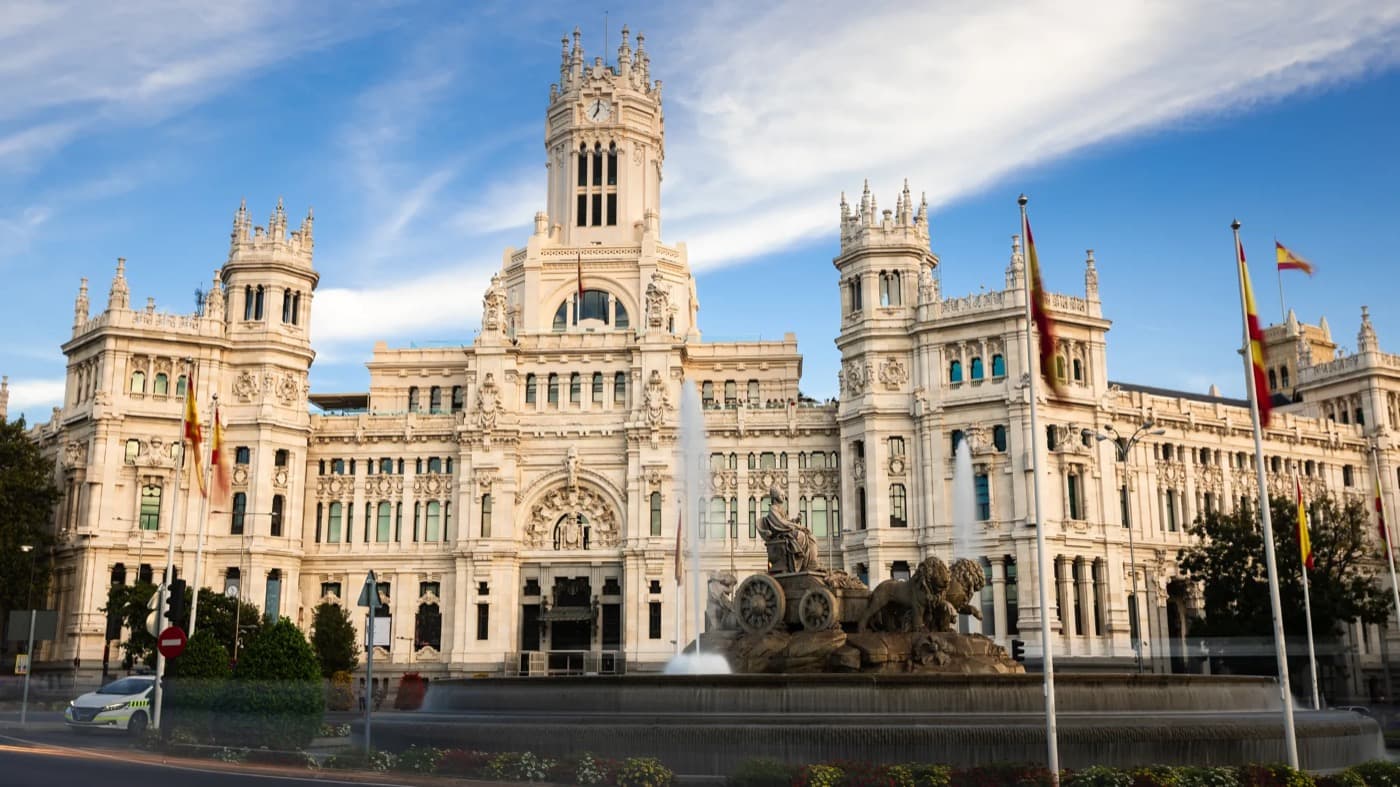
Before we get to who built it and why, it helps to understand what the building means in the present day. The Cibeles Palace is now home to Madrid City Hall and to CentroCentro, a lively cultural space that hosts exhibitions and events throughout the year. Its rooftop terrace, meanwhile, delivers some of the finest views in the city, which is why it has become an essential stop for anyone visiting.
Origins of the project
Construction of the Cibeles Palace began in 1907, and the building was inaugurated in 1919. Its original purpose had nothing to do with city government or culture. It was designed as the headquarters of Spain's Postal and Telegraph Service, which is why it first went by an entirely different name: the Palacio de Comunicaciones, or Communications Palace. At a time when the country was racing to modernize, the building was meant to embody the boom in national communications and stand as a symbol of progress.
Why not experience it with a local guide?
Book a free tour through central Madrid: local guides, small groups and no upfront payment.
See the free tours →The architects behind the design
The design was entrusted to two Spanish architects, Antonio Palacios and Joaquin Otamendi. They set out to create far more than a functional post office. Their goal was a monument, one that fused traditional architectural language with the innovations of their era. The result blended a modernist spirit with neo-Gothic and Baroque touches, producing a building that still stops locals and travelers in their tracks.
- Antonio Palacios: celebrated for his modernist style and regarded as one of the most influential Spanish architects of the twentieth century. His other Madrid works include the Circulo de Bellas Artes building.
- Joaquin Otamendi: Palacios's partner and frequent collaborator, who brought deep experience in large-scale urban projects.
Why the Cibeles Palace was built
The Cibeles Palace answered two needs at once: a very practical one, and a far more ambitious political and cultural one.
A modern communications hub
In the early twentieth century, Madrid was in the thick of a sweeping modernization. The authorities of the day wanted a signature building that reflected how vital communications had become in an increasingly connected world. The Cibeles Palace became the new home of the postal service, fitted with up-to-date facilities designed to keep the mail and the telecommunications running smoothly and efficiently.
A symbol of progress
The building was never meant to be merely useful. It carried a clear symbolic charge: to prove that Spain, and Madrid in particular, could stand alongside great European capitals such as Paris and London in matters of architecture and modern life. The Cibeles Palace rose as a statement about the city's place on the international stage.
How the Cibeles Palace changed over time
Over the decades, the building's role shifted. In 2007 it was converted into the seat of Madrid City Hall, adapting to the demands of the twenty-first century without shedding its historic character. That same renovation also opened its doors to the public as a cultural venue. Today the palace is not only an administrative center but a meeting point for locals and visitors alike, offering everything from exhibitions to sweeping panoramic views.
Why you should visit the Cibeles Palace
Beyond its fascinating history, the Cibeles Palace is an architectural gem. Its location alone makes a strong case: standing on Plaza de Cibeles, at the very heart of the city, it is an ideal launching point for nearby attractions such as Parque del Retiro and Gran Via.
- One-of-a-kind architecture: every detail, from the columns to the towers, reflects the imagination of its designers.
- The rooftop terrace: climbing to the top rewards you with one of the best views in all of Madrid.
A few lesser-known facts about the Cibeles Palace
Did you know the Cibeles Palace was once nicknamed Nuestra Senora de las Comunicaciones, or Our Lady of Communications? The affectionate title captured both the sheer grandeur of the building and how important it was in its day. Here is another intriguing detail: its construction cost close to ten million pesetas, a staggering sum for the time.
Why not experience it with a local guide?
Book a free tour through central Madrid: local guides, small groups and no upfront payment.
See the free tours →Conclusion
The Cibeles Palace is far more than a building. It is a portrait of Madrid's history, its drive to modernize, and its restless, inventive spirit. If a trip to the Spanish capital is on your horizon, do not pass up the chance to see it up close. The best way to take in this landmark, and the many stories woven through the streets around it, is on foot, and a free tour is a wonderful way to let the city reveal its secrets one corner at a time.
Why not experience it with a local guide?
Book a free tour through central Madrid: local guides, small groups and no upfront payment.
See the free tours →